The feasibility of a real estate project is no longer determined solely on the construction site, but rather through the strategic intelligence behind capital allocation. Traditional financing models are often the greatest obstacle to corporate agility, delaying highly viable projects within a web of institutional bureaucracy. The answer to financial disintermediation in the high-end construction sector has a name: BTR3 – Built to Rent.
What is CH3 Construtora’s BTR3?
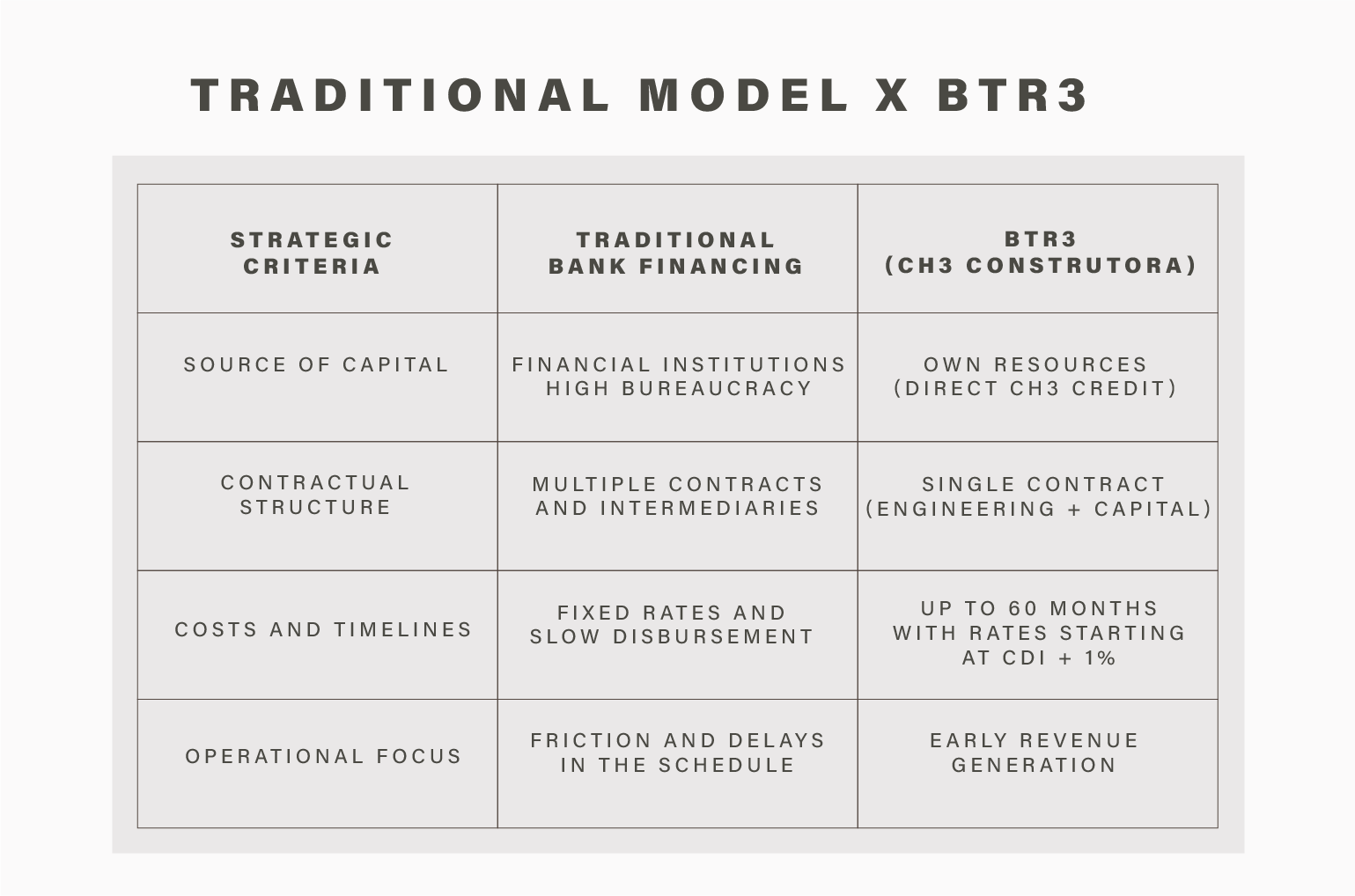
BTR3 is an exclusive financing model developed by CH3 Construtora that allows construction projects to be paid in installments of up to 60 months. It integrates engineering and proprietary capital into a single contract, eliminating banking bureaucracy and streamlining the client’s investment process.
The essence of this solution, recently highlighted in an exclusive interview with the SiiLA platform, is autonomy. According to Bruno Chohfi, partner at CH3 Construtora: “The client does not need to approach a bank to structure the financing. Engineering and capital are within the same contract.”

How does the conversion of CapEx and OpEx work in installment-based construction?
The BTR3 model strategically transforms short-term CapEx into long-term OpEx. This flexibility preserves cash flow, ensuring that your high-end corporate project becomes operational and starts generating revenue before full repayment.
Instead of decapitalizing the company with heavy upfront capital expenditures (CapEx), the BTR3 structure allows costs to be absorbed predictably as operating expenses (OpEx). This approach provides not only financial stability, but also significant tax benefits, such as deductibility under the Real Profit tax regime.
How does BTR3 help reduce vacancy in commercial properties?
BTR3 addresses vacancy by enabling property owners to modernize obsolete assets without immediate capital outlay. By allowing construction costs to be paid in installments of up to 60 months, properties gain accelerated competitiveness to attract high-end tenants, transforming idle spaces into income-generating assets with both technical and financial agility.
This model is a critical differentiator in today’s market. In São Paulo, for example, the vacancy rate for high-end corporate office spaces reached 13.32% in the first quarter of 2026, according to official data from Buildings CRE Tool. BTR3 directly tackles this bottleneck through:
- Enabling Retrofits: modernization of older buildings to “AAA” standards without compromising cash flow.
- Accelerating the Flight to Quality: delivery of modern infrastructure that meets new ESG and technology demands.
- Self-Financing: owners can use cash flow from new leases to repay modernization installments.
What are the advantages of a Turnkey project with BTR3?
Combining the Turnkey model with BTR3 centralizes all project stages within a single contract. CH3 delivers a high-end, ready-to-use space, ensuring agility, rigorous mitigation of engineering risks, and full financial predictability.
For corporations seeking efficiency, the advantages of carrying out installment-based construction under this model include:
- Credit Autonomy: elimination of dependence on, and delays from, traditional bank approvals.
- Cost Efficiency: highly competitive conditions that ensure a smooth and continuous construction process.
- Engineering Risk Mitigation: CH3 assumes end-to-end responsibility, shielding the client from technical uncertainties and cost overruns.
The role of the modern construction company goes beyond the physical act of building. Delivering outstanding corporate spaces means enabling the human and strategic growth of businesses. By eliminating financial friction through BTR3, leaders and teams are empowered to focus on what truly matters: innovation and business expansion within an inspiring environment.
When engineering is combined with intelligent financial strategy, it evolves from a cost center into a primary driver of corporate growth.
Discover how financial intelligence is reshaping the market by reading the full feature on CH3 in the SiiLA Portal.
LATEST PUBLICATIONS